Keep the skid 4 m long.
Carry this fixed input into the proposal. Confirm the equipment envelope against the source file.
Input retained in the local demoPRODUCT / INSIDE A CHANGE
For an OEM, a changed dimension can send an order back through design, checking and documentation. The aim is engineering that recalculates like a spreadsheet: connected inputs, visible dependencies and a result a person can review.
THE CUSTOMER REQUEST
“The equipment is 800 mm longer. Keep the four-metre skid.”
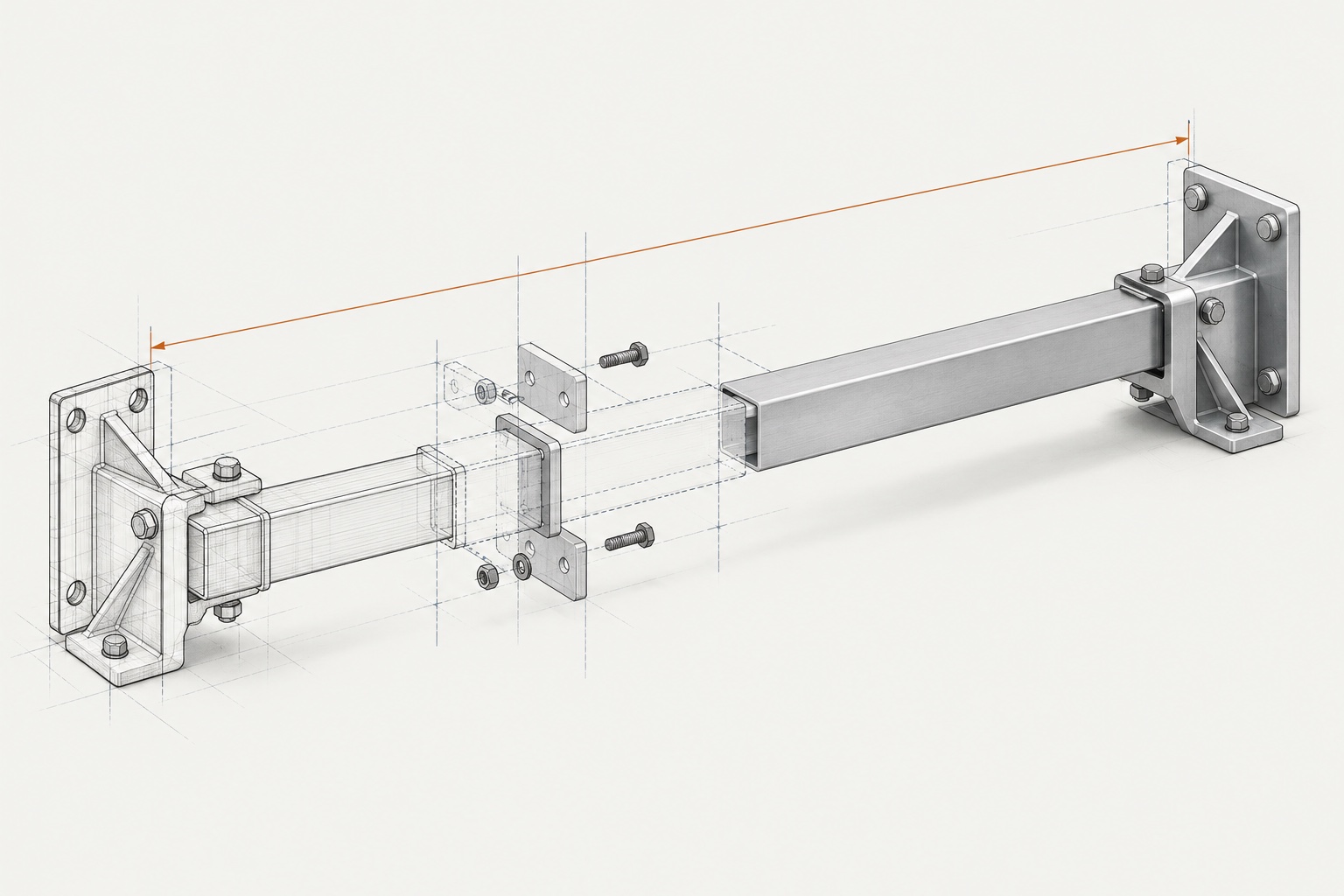
This example describes the intended connected workflow. Available operations depend on the design family, implemented checks and configured connections.
The customer asks for 800 mm more equipment length. Keep the email, the equipment envelope, the meeting decision and the Slack clarification with reference revision A.
SOURCE → REQUIREMENT + REVISIONRetain the 4 m skid, 1.6 m runner spacing and 1.2 m equipment width. Separate the family’s cross-member spacing assumption from regulations whose applicability the engineer must establish.
CONTEXT → INPUTS + DEPENDENCIES TO REVIEWA connected AI client can request a skid equipment-length change through MCP. Preview returns the changed inputs, diff and kernel checks without saving; explicit adoption creates a new revision after review. The linked demo calculates directly from selected inputs.
AI CLIENT → TYPED CHANGE → REVIEWThe existing skid kernel repositions the four mounting datums and changes cross-members from 5 to 6. Total member cut length changes from 15.965 to 17.558 m; assumed-section frame mass changes from 653.2 to 718.4 kg.
DETERMINISTIC OPERATIONS → UPDATED OUTPUTSThe reviewer compares A with proposed B, confirms the source inputs and addresses the open engineering scope. An adopted change becomes a new saved revision; source A remains the reference. This public walkthrough saves nothing.
HUMAN DECISION → ACCEPTED REVISION OR REWORKFor an OEM product family, the supported inputs, dependencies, checks and professional review responsibilities are agreed as part of the engagement.
One request, four supporting records. Choose a record, then follow the same equipment-length change. This diagram explains the intended workflow; it does not run a design change. Connections and operations depend on setup and design family.
Customer email · requested change“The equipment is 800 mm longer. Keep the four-metre skid.”
PROJECT ACCESS & REVISION CONTEXT
The project record serves as the customer’s data room: original files, messages, decisions and their sources. This synthetic example shows how each record contributes to the same request.
The customer asks for 800 mm more length. The existing equipment footprint is 1,200 × 1,200 mm; the skid must remain 4,000 mm long.
REFERENCE A → PROPOSED B · SYNTHETIC PROJECT RECORD
For this change, equipment length varies while the skid length, runner spacing and equipment width stay fixed. Context must say where each requirement came from and whether it is actually checked.
Carry this fixed input into the proposal. Confirm the equipment envelope against the source file.
Input retained in the local demoThe existing geometry kernel inserts cross-members around the mounting positions and fills wider gaps. This is a stated modeling assumption, not a regulation.
Implemented geometry rule · 5 → 6 cross-membersRecord the intended use, destination, applicable source and edition with the engineer. The geometry example does not assess lifting hardware, welds or regulatory compliance.
Applicability and supporting evidence still requiredPublished regulations inform the review scope. They become executable checks only where a specific rule, required facts and implementation have been established; attaching a document does not create a compliance result.
A connected AI client submits a set-skid-dimension operation for equipLengthM through MCP. Nordform validates the operation and returns a preview for review. The proposed equipment length changes; the fixed dimensions remain available for validation and review.
equipLengthM: 1.2 → 2The machinery-skid example runs the existing geometry kernel locally. Both alternatives use the same assumed 200 mm I-section and 4 m skid.
| Output | A | B |
|---|---|---|
| Cross-members | 5 | 6 |
| Total member cut length | 15.965 m | 17.558 m |
| Frame mass, assumed section | 653.2 kg | 718.4 kg |
| Mounting datums | 4 original | 4 repositioned |
Geometry fit is checked against the stated inputs. These quantities do not establish member strength, lifting suitability or production release.
Try this exact equipment change ↗A reviewer inspects the source request, fixed inputs, calculation results and unresolved engineering questions before adopting a proposal. The sample record below shows what that decision needs to distinguish.
Sample record for explaining the workflow. No revision is saved and no approval is granted from this page.
Try the machinery-skid recalculation example ↗ These are cooperating parts of the system. Context informs the work, connections move information, the project record retains it, and people control the decisions.
Keep the source material, conversations and decisions connected to the work. Private originals, design messages and imported meeting notes have different entry points and access rules.
Regulations, standards, manufacturer information and company rules give a design its context. Versioned sources retain the recorded source information and evidence used by a run, including jurisdiction and edition where established.
Nordform Connect brings together the design hub’s message history and the interfaces recorded between designs. These functions make proposals, dependencies and handoffs visible.
Agentic workflows combine non-deterministic reasoning with deterministic operations. The AI proposes a structured change; the supported design system owns geometry, calculations and exports.
Review the proposal and its evidence before adopting a change. Findings, decisions and sign-offs belong to a stated revision and scope.
Files, messages, selected context and saved revisions are governed by the project's access rules.
Depending on the operation, the request, parameters, selected document text, images or meeting notes are sent to a model provider. Retention and processing terms vary by provider and feature.
Structured response returns to the workflow ↓Validate the proposal, run permitted operations and attach available results to the proposed revision.
Review the evidence and unresolved issues. A connection or model response does not grant adoption authority.
Project access and external processing are separate boundaries. This diagram describes information handling, not a claim that all computation happens inside a private customer environment.
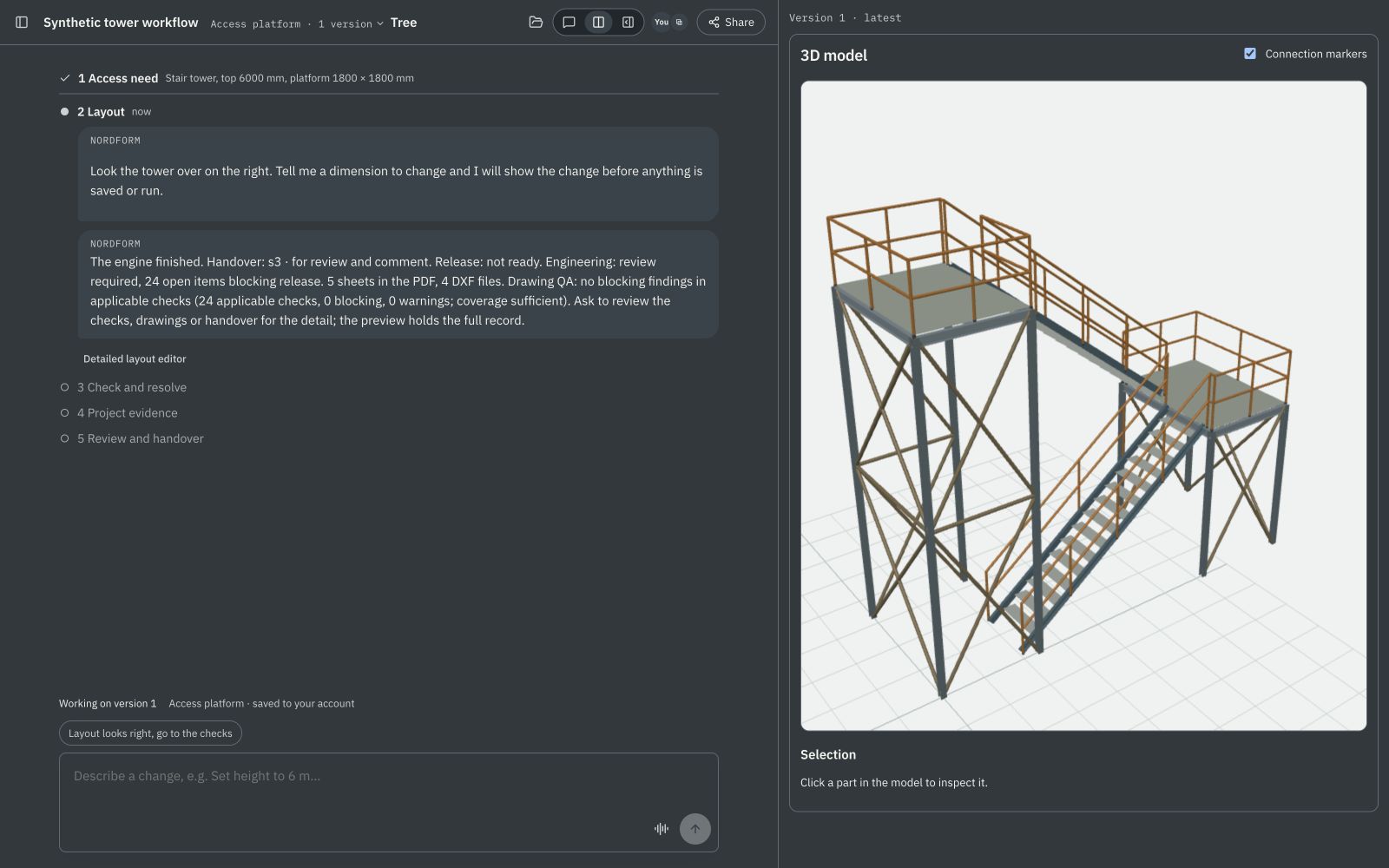
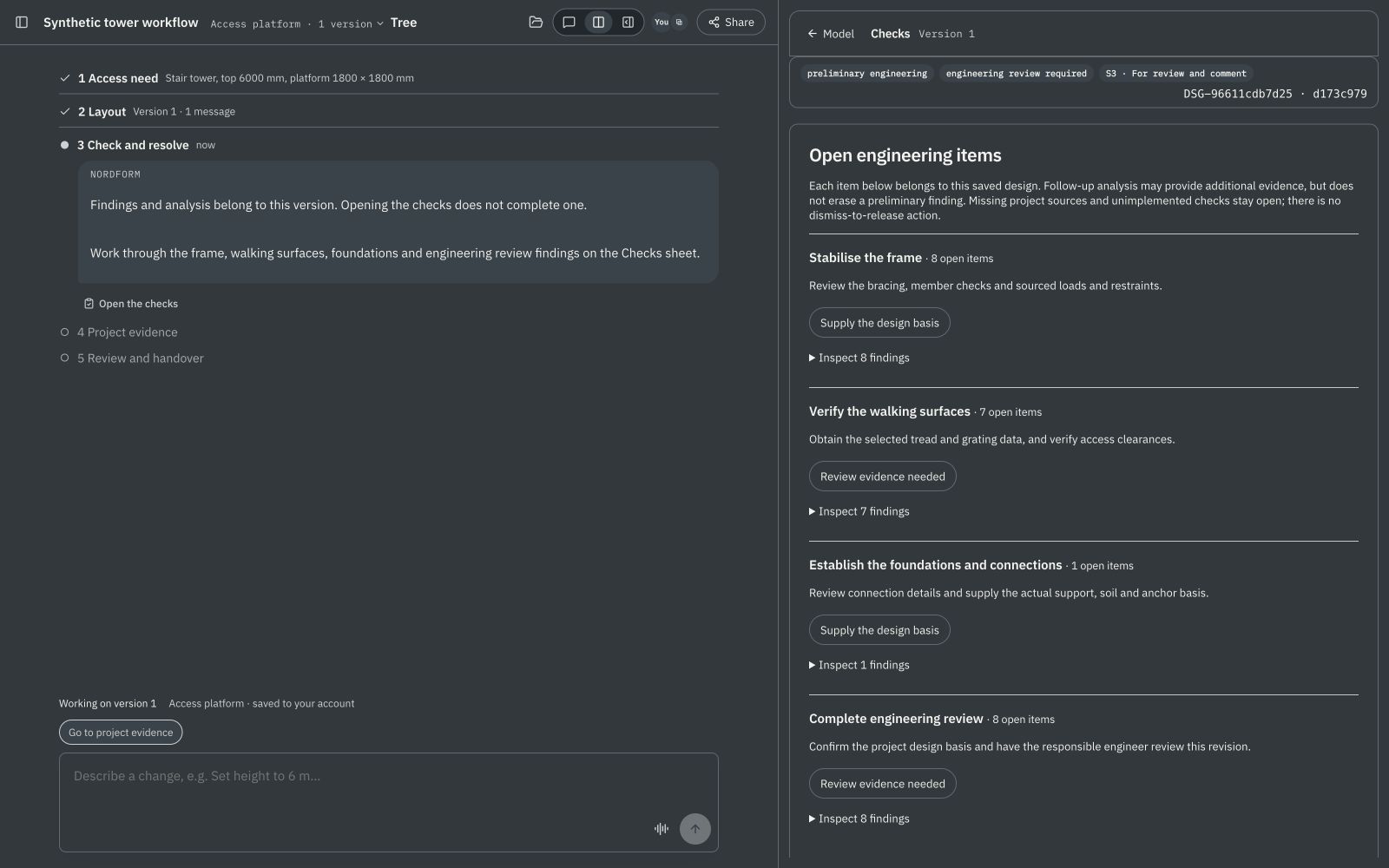
Actual interface captures from a synthetic steel-access-platform demonstration. These separate interface captures show the wider industrial workspace and its open engineering checks. Follow the equipment-length example above for the connected change story.
Choose a recurring engineering change. Define the inputs, the checks and the decisions that should stay with your team.
Discuss your workflow ↗